Friday, April 19, 2013

Legends of the Kainai


Share

0
Legends of the Kainai: Stories from the Blackfoot People of southern Alberta


Legends of the Kainai

Dramatizations of the old stories of the Blackfoot of southern Alberta, provide a glimpse into this ancient culture's sacred beliefs, traditions and heroes. CBC Radio's Legends Project compiles traditional oral stories, legends and histories of Canada's Inuit and First Nations, gathered in communities across the country.

To find out more, visit the Legends Project website.


This segment features dramatized versions of traditional Blackfoot legends recorded in March 2007, on the Blood Reserve in southwestern Alberta. These legends are only a small part of the many hours of stories told by Blackfoot elders of the Blood Tribe (Kainai), in their original language. It is the hope that these precious recordings will help preserve the endangered language of the Kainai and will showcase the traditional lifestyle, history, values and creation myths as they were shared by the Blackfoot for more than 10,000 years.

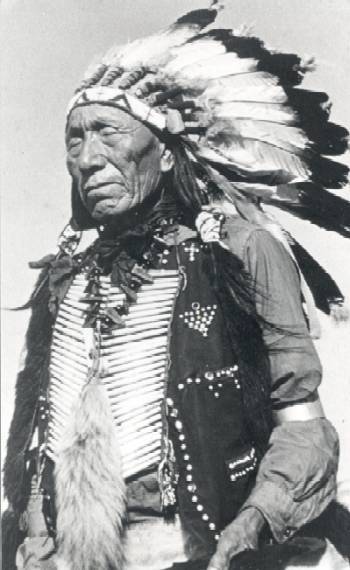
Once referred to as "Lord of the Plains" the Blackfoot Confederacy were one of the most feared and respected warrior nations. They dominated the plains from the Rockies to Saskatchewan, living nomadically in Niitoyisi (tipis) made from buffalo hides and poles. With the assistance of dogs and later horses, the Blackfoot followed the herds of buffalo, which provided them sustenance. They lived in camps made up of families and clans, adhering to a complex governing system and protocol. They shared stories, traditions and celebrations that reflected their vast knowledge of the land, sky, plants and animals. This knowledge helped them thrive for thousands of years on North America's prairies.

Compared to other First Nations the Blackfoot were colonized relatively late. Although there have been generations of assimilation through residential schools and other means, their cultural and sacred traditions, along with their language, remains intact. This continues to be threatened by dominant English media. Many traditional Blackfoot stories are still told today that explain rituals, sacred duties and ceremonies practiced since the beginning of time. Involvement in these sacred societies, such as the Horn, Dove and Crazy Dogs is often mandatory and it is these societies that have protected the cultural pride, belief system, songs, stories and Blackfoot ways of life, even though they were outlawed until recent times.



Source:  http://www.cbc.ca/ideas/episodes/2013/04/19/legends-of-the-kainai/


Wednesday, January 9, 2013

Invisible Indian: Federal Court grants rights to Métis, non-status Indians


 “ The growing and dying of the moon reminds us of our ignorance which comes and goes—but when the moon is full it is as if the Great Spirit were upon the whole world. ” 

—Black Elk, Oglala Sioux


Federal Court grants rights to Métis, non-status Indians

Off-reserve aboriginal people are 'Indians' and entitled to same constitutional rights

The federal government has lost the latest battle in a 13-year legal fight over its responsibilities to Métis and non-status Indians.
On Tuesday, the Federal Court ruled that 200,000 Métis and 400,000 non-status Indians in Canada are indeed "Indians" under the Constitution Act, and fall under federal jurisdiction.
The decision helps to more clearly outline Ottawa's responsibilities toward the two aboriginal groups.
"The recognition of Métis and non-status Indian as Indians under section 91(24) should accord a further level of respect and reconciliation by removing the constitutional uncertainty surrounding these groups," Federal Court Judge Michael Phelan writes.


Invisible Indian


source:
Federal Court grants rights to Métis, non-status Indians - Politics - CBC News

 http://www.cbc.ca/news/politics/story/2013/01/08/pol-cp-metis-indians-federal-court-challenge.html

Federal Court grants rights to Métis, non-status Indians - Politics - CBC News

The federal government has lost the latest battle in a 13-year legal fight over its responsibilities to Métis and non-status Indians.
On Tuesday, the Federal Court ruled that 200,000 Métis and 400,000 non-status Indians in Canada are indeed "Indians" under the Constitution Act, and fall under federal jurisdiction.
The decision helps to more clearly outline Ottawa's responsibilities toward the two aboriginal groups.
"The recognition of Métis and non-status Indian as Indians under section 91(24) should accord a further level of respect and reconciliation by removing the constitutional uncertainty surrounding these groups," Federal Court Judge Michael Phelan writes.
'Today's decision will mark a new relationship with the government of Canada. Let's be honest. It's not going to change it immediately. It's not going to change it tomorrow.'—Betty Ann Lavallée, Congress of Aboriginal Peoples
The decision does not go so far as to declare that the federal government has a fiduciary responsibility to the two groups, but it says such duties would flow automatically now that their standing has been clarified.
"There is no dispute that the Crown has a fiduciary relationship with aboriginal people both historically and pursuant to section 35 (of the Constitution)," Phelan writes.
However, he adds: "That duty is not an open-ended undefined obligation but must be focused on a specific interest."

Politics to the politicians

Melanie Omeniho, president of the Women of the Métis Nation, said the ruling means that "we will no longer be a part of the political football that has us being tossed back and forth between the province and the federal government."
National Chief Betty Ann Lavallée of the Congress of Aboriginal Peoples speaks about the impact of a federal court decision on Métis and non-status Indians during a news conference Tuesday in Ottawa.National Chief Betty Ann Lavallée of the Congress of Aboriginal Peoples speaks about the impact of a federal court decision on Métis and non-status Indians during a news conference Tuesday in Ottawa. (Adrian Wyld/Canadian Press)One complaint among non-status or Métis people is that for years they have been told they were a provincial responsibility, only to have the provinces tell them they were the purview of the federal government. That had left them in a jurisdictional limbo, said Robert Janes, a Victoria lawyer who focuses on aboriginal issues but was not involved in the case.
But Sebastian Grammond, an expert historical witness in the case, told CBC News the ruling does nothing to settle the issue of how the federal government will exercise its jurisdiction.
"The judge answered a legal question but left the politics to the politicians," he said. "Differences of treatment [between status and non-status aboriginals] will have to be justified in a rational way rather than just saying, 'Oh, sorry, we don't have jurisdiction over you.'"
Betty Ann Lavallée, the National Chief for the Congress of Aboriginal Peoples — the group that represents aboriginal people living off-reserve across Canada — paid tribute to the work of the late Harry Daniels, the former leader who started the case on behalf of her organization.
"This case was all about fairness, dignity, self-worth," she said, saying that until now, non-status aboriginals were treated as "second-class citizens.
"Today's decision will mark a new relationship with the government of Canada," she said. "Let's be honest. It's not going to change it immediately. It's not going to change it tomorrow."
Lavallée said the legal fight cost her group more than $2 million and that over the past 14 years, the money that the federal government spent trying to have it thrown out could instead have gone toward "addressing some of the key issues that the court decision speaks to."

Case dates to 1999

The Congress of Aboriginal Peoples and several Métis and non-status Indians took the federal government to court in 1999 alleging discrimination because they are not considered "Indians" under a section of the Constitution Act.
They argued they are entitled to some or all of the same rights and benefits as status First Nations members, many who live on reserves.
They say that includes access to the same health, education and other benefits Ottawa gives status Indians; being able to hunt, trap, fish and gather on public land; and the ability to negotiate and enter treaties with the federal government.
The congress and the Métis and non-status Indians involved in the case alleged in court documents that they've been the victims of "deprivations and discrimination" by the federal government.
'The Métis have some wind in their sails'—Jason Madden, lawyer for the Métis National Council
Jason Madden, a lawyer representing the Métis National Council, told CBC News Network that "it's a good day for the Métis nation" and that Tuesday's ruling "removes an obstacle" in their relationship with the federal government — clarifying that in fact the federal government does have jurisdictional responsibilities to provide services to the Métis.
"We know what door to knock on," Madden said. "We have a solid court decision to start the onslaught of litigation."
Madden said the decision will allow the Métis to move forward with negotiations to determine what remedy may be required for past discrimination –— when Métis were not considered as equals with status Indians and Inuit.
"What we are hoping is … based upon negotiations that they will find a place for the Métis in how [the] Indian Affairs [department] currently operates," he said. "The Métis have some wind in their sails."
The president of the Manitoba Métis Federation said they are taking Tuesday's ruling cautiously, and wanting to make it clear that the Métis identity will not be lost.
"We have to be very cautious about the decision because being classified or bundled together as just Indians, or the title Indians, you know categorized as one group … we are our own nation," said David Chartrand, who is also vice-president of the Métis National Council of Canada.
The decision is widely expected to be appealed to the Supreme Court, and the federal government's reaction on Thursday suggested it was contemplating taking another go at it.

Government weighing decision

"We are reviewing the court's decision to determine the next steps," said Jan O'Driscoll, spokesman for Aboriginal Affairs Minister John Duncan.
"Our government continues to work in partnership with all aboriginals across Canada to address shared priorities such as education, economic development and jobs."
He noted that the Federal Court said its decision is not about "the interpretation or application of particular rights either under the Constitution or under specific agreements, nor is it about aboriginal rights."
Conservative Senator Patrick Brazeau, who is former national chief of the Congress of Aboriginal Peoples, told host Evan Solomon on CBC's Power & Politics that the court's decision and the Idle No More protest movement are part of a national discussion he sees as an opportunity.
"Whether it's appealed or not, it will be a negotiations process between non-status organizations and Métis organizations with the federal government," he said. Again, it's all part of an ongoing dialogue that's taking place."
The court did not get specific about what the federal government should actually do now that Métis and non-status Indians fall into the broader category of "Indians."
"The court is not prepared to make some general statement concerning fiduciary duty," Phelan's ruling states.
"Given the declaration of right in respect of section 91(24), one would expect that the federal government would act in accordance with whatever duty arises in respect of any specific matter touching on the nonclarified fiduciary relationship."
Phelan plowed through constitutional and aboriginal history going back to before Confederation to come to the conclusion that Métis and non-status Indians should actually be considered Indians under modern law.
The case for Canada's 400,000 non-status Indians was more clear-cut than the case for the 200,000 Métis, but on balance, historical evidence weighs in favour of the Métis too, he wrote.


Federal Court grants rights to Métis, non-status Indians - Politics - CBC News


Sunday, December 30, 2012

Quotes


“ The growing and dying of the moon reminds us of our ignorance which comes and goes—but when the moon is full it is as if the Great Spirit were upon the whole world. ”


—Black Elk, Oglala Sioux

Indian Country Today Media Network


“ The growing and dying of the moon reminds us of our ignorance which comes and goes—but when the moon is full it is as if the Great Spirit were upon the whole world. ”


—Black Elk, Oglala Sioux


Native American Indian News, Articles, Culture, Events and More


Indian Country Today Media Network’s home page is the digital gateway to the world’s most comprehensive and innovative online Native news and entertainment site, serving Native and American Indian tribes nationwide.

It features Native American Journalism Association award-winning writers and reporters, and a team of columnists composed of tribal leaders, members of Congress, and the foremost Native thinkers, writers, and artists in Indian Country. 

ICTMN’s featured articles cover a vast array of subjects such as Native and American Indian opinions, politics, arts, environment, genealogy, and more.

Updated many times a day, this site delivers to our audience rich, fascinating articles with captivating pictures and videos and daily late-breaking news alerts featuring the most-up-to-date current events about Native and American Indian culture throughout the web.


 (NOTE: ICTMN prefers not to use Native American as a general descriptive term, as indigenous peoples predate the formation of the United States and are distinct from ethnic categorization.)


Read more:http://indiancountrytodaymedianetwork.com/ http://indiancountrytodaymedianetwork.com/#ixzz1duqVyTzz


http://indiancountrytodaymedianetwork.com/


jack d. forbes Novel: red blood


Jack d. forbes, red blood

 jack d. forbes, university of california, davis, professor of native american studies.  I'm starting with one of his scholarly books, "The American Discovery of Europe" and also his only novel, "Red Blood."  I am really impressed by the novel.  It is written in the peripatetic motif popularized in the English tradition by Smolett, but found also in that sperm-seed of western literature, Don Quixote. So, nothing much happens, there is no suspensful 'plot,' but the protagonist, Jesse, travels around and meets different people of various native american backgrounds, reflects on what he sees, and gains insight into what it means to be native american, or part-native american, at this particular juncture in time. 

It seems to me he covers every possible permutation.

It's a great loss that Jack Forbes has recently died, in February 2011, because he was clearly a man of great insight with a basically gentle attitude toward differences, a lot of love, compassion and intelligence.  A jewel.  He was of Powhatan-Renape and Lenape background, which may mean he looked more brown or more white than the popular conception of what 'Native American' looks like.  He writes a LOT about all the various shades of color and subtleties of feature found in our population.  Young white readers, in particular, (from what I've seen in the comments on blogs that deal with these issues) often find this kind of writing 'racist,' but really, it's just revealing the racism that is already there in our society, but goes unacknowledged.  There's been a fairly large acknowledgement of the racism heir to the plantation-slavery of Africans prior to the Civil War, but there is less awareness of the widespread slavery prior to the rise of the South's cotton industry.  Slavery or indentured servitude were very common throughout the thirteen colonies and early states and involved white, black and red persons, who often united in bands of community and through marriage.  Their descendents, along with the descendants of many later immigrants, form the 'unentitled' masses of America. 

For people who fall into that latter category, 'Red Blood' is a helpful book.  For people like myself, with perhaps only a smidgen of native blood but a fairly wide streak of influence from the native forbears, it is comforting to see just where these influences come from, and that we have a sort of 'right' to our beliefs and our lifestyle.  We are not simply somehow defective white people or 'anti-social' or whatever label might have been applied to us in our difference.  We are not simply 'black' Americans, either, but that is someone else's story to tell, not mine.

For myself, to look at me, I understand why no one would credit that I am part-native american, or part African, even though my dna tests show that, and my family (barely) acknowledged it, regarding it as something too precious to share abroad, only eliciting criticism, ridicule or negativity.  Rather, our truth was like a precious pearl kept secret in a special container deep inside our home.  Anyway, I'm not going to try to convince anybody - about myself, I mean.  It will be a fairly private thing for me, and an online post doesn't really change that.

I look forward to reading more Jack Forbes and I encourage you to read him too.


jack d. forbes, red blood - Great Grandmother's Blog

 Link:  http://knitandcontemplation.typepad.com/great_grandmothers_blog/2011/04/jack-d-forbes-red-blood.html


Native American Experience


Learn about the life, culture and history of the Native American people.


Nerburn, Kent
The Wolf at Twilight : an Indian Elder's Journey Through a Land of Ghosts and Shadows
The author finds himself back on the Lakota reservation where he traveled more than a decade before with a tribal elder named Dan. This touching, funny, and haunting journey goes deep into mysteries of reservation boarding-schools, sweat lodges, and the isolated homesteads of the Dakota hills.
2009
Adult Nonfiction Book

Northrup, Jim
Anishinaabe Syndicated : a View from the Rez
Northrup, an Anishinaabe writer, takes a humorous look at life on and off the Fond do Lac Reservation in northern Minnesota, including traditional ricing and fishing, pow wows and casinos, family relationships, politics, pets, boarding schools, and travel. 2012 Minnesota Book Award nominee.
2011
Adult Nonfiction Book

Peacock, Thomas D.
Ojibwe Waasa Inaabidaa = We Look in All Directions
Chronicles the history and culture of the Ojibwe people. Peacock, an Ojibwe himself, discusses the written language of the Ojibwe, their 500-mile migration to Northern Michigan from the St. Lawrence River valley, their struggles with the U.S. Government over sovereignty and land issues, and other historical issues.
2002
Adult Nonfiction Book

Peltier, Leonard
Prison Writings: My Life Is My Sun Dance
Incarcerated for the last twenty-four years, the Native American activist shares his life story, as well as philosophical views on prison and how it has affected him.
1999
Adult Nonfiction Book (Biography)

Razor, Peter
While the Locust Slept
This memoir, written when the author was 73 years old, won a Minnesota Book Award. Razor describes his experiences as an orphan growing up at the State Public School in Owatonna and the severe abuse he suffered. As an adult, he gained strength from researching his Native American heritage.
2001
Adult Nonfiction Book (Biography)

Swift, Tom
Chief Bender's Burden : the Silent Struggle of a Baseball Star
The story of Bender's improbable journey--from his early years on the White Earth Reservation, to his development at the Carlisle Indian School, to his big break and eventual rise to the pinnacle of baseball.
2008
Adult Nonfiction Book

Treuer, Anton
The Assassination of Hole in the Day
Explores the murder of the controversial Ojibwe chief who led his people through the first difficult years of dispossession by white invaders—and created a new kind of leadership for the Ojibwe. A Minnesota Book Award nominee.
2011
Adult Nonfiction Book

Treuer, Anton.
Everything You Wanted to Know About Indians but Were Afraid to Ask
What have you always wanted to know about Indians? In matter of-fact responses to over 120 questions, both thoughtful and outrageous, modern and historical, Ojibwe scholar and cultural preservationist Anton Treuer gives a frank, funny, and sometimes personal tour of Native people and their culture.
2012
Adult Nonfiction Book

Treuer, David.
Rez Life : an Indian's Journey Through Reservation Life
Celebrated novelist David Treuer has brings a novelist’s storytelling skill and an eye for detail to a complex and subtle examination of Native American reservation life, past and present.
2012
Adult Nonfiction Book

Vizenor, Gerald Robert
The Everlasting Sky: Voices of the Anishinabe People
This classic collection of essays portrays the peoples and political times on northern reservations in the 1970s. Many of the writings are drawn from the author’s experiences growing up on the White Earth Reservation in Minnesota.
2000
Adult Nonfiction Book

Warren, William W.
History of the Ojibway People
For the first time since its initial publication in 1885, this classic text is now available with new annotations. Warren collected firsthand descriptions and stories from relatives, tribal leaders, and acquaintances and transcribed this oral history of the Ojibwe.
2009
Adult Nonfiction Book

Weatherford, J. McIver
Indian Givers : How Native Americans Transformed the World
Chronicles 500 years of contributions from the Indians of the Americas by anthropologist Jack Weatherford, including our federal government, democratic institutions, modern medicine, agriculture, architecture, and ecology.
2010
Adult Nonfiction Book

White, Bruce M.
We are at Home : Pictures of the Ojibwe People
A fascinating history of the Ojibwe people at home in the Minnesota landscape through 1950--as told through more than 200 vivid photographs.
2007
Adult Nonfiction Book

Wilson, Diane, 1954-
Beloved Child : a Dakota Way of Life
Through interviews with cultural activists and Dakota elders, Dianne Wilson, tells stories of restoration and reconciliation, and the efforts of modern Native American activists to empower their people in the wake of genocide and the forced enculturation of the boarding school system.
2011
Adult Nonfiction Book


Hennepin County Library - Find a Good Book - Native American Experience